The Nazca: Climate Fear, Headhunting, and Other Timeless Sports
Some two thousand years ago, when my ancestors were romping about Europe asking guidance of sheep entrails, sacrificing to Odin and Zeus, and adding to their collections of dismembered human heads, something quite different was underway in the highlands of Peru.
The people there were asking guidance of guinea pig entrails, collecting dismembered heads, and sacrificing to Kon, the god of rain. And in those days, before the troubles came, they were a cheerful civilization. Headhunters, yes, but with a decidedly artistic bent.
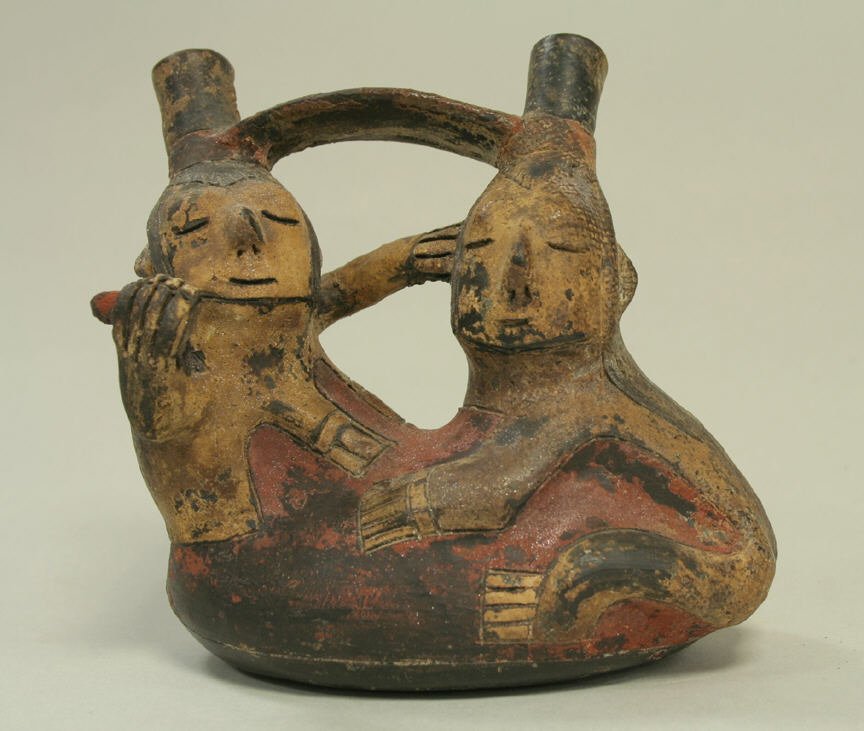
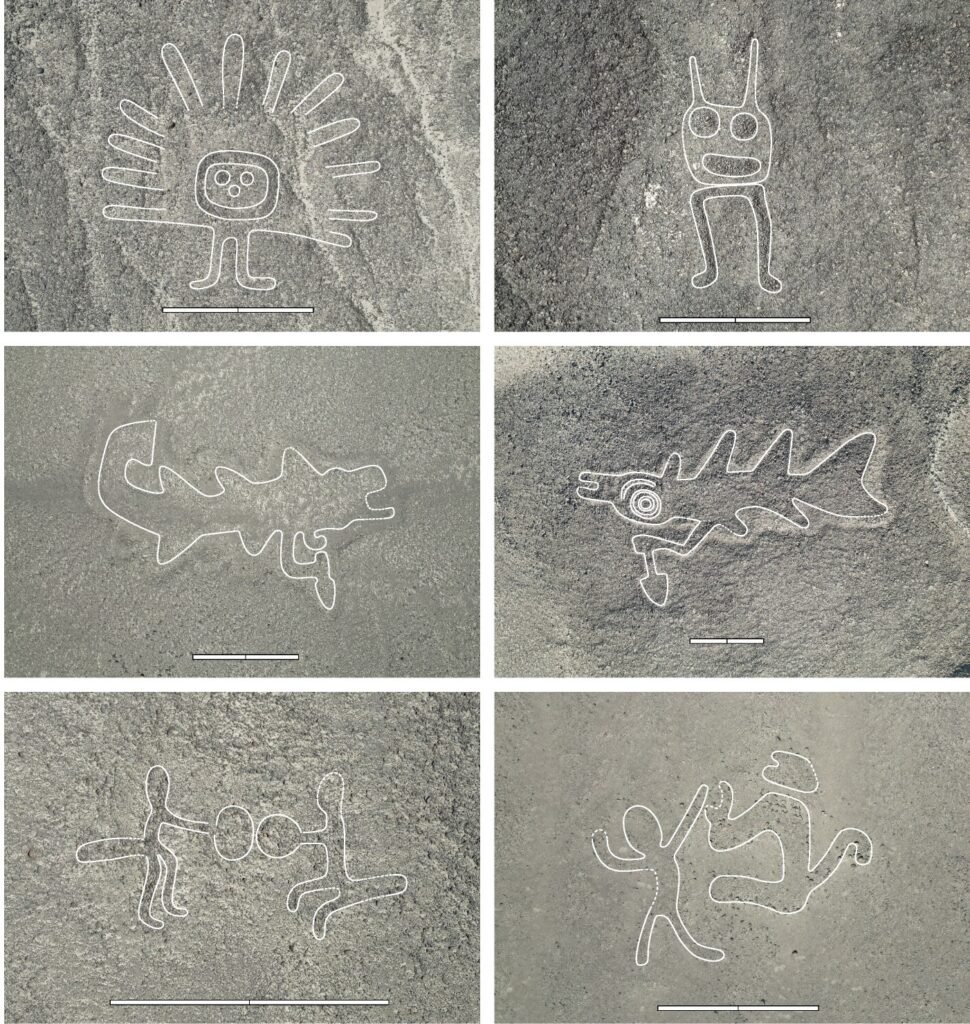
They created intricate embroidery, wove brilliantly detailed cloth, and when they’d had enough of textiles for the day, they liked to exercise their creativity on a grand scale. These precursors to the Nazca carved hundreds of figures, ranging in size from six to 100 feet across, onto hillsides where they would be visible to the neighbors. They preferred to draw figures that told some kind of story—happy family groups, Auntie sporting her new headdress, or a hunter going home with his newest head. Some drawings may have functioned as huge glyphs with the family crest, like the signs we put above our doors announcing “The Jones’s Family” (extra apostrophe added for authenticity). But most hillside drawings appear to have been purely art for art’s sake.
Well, that and to impress visitors.
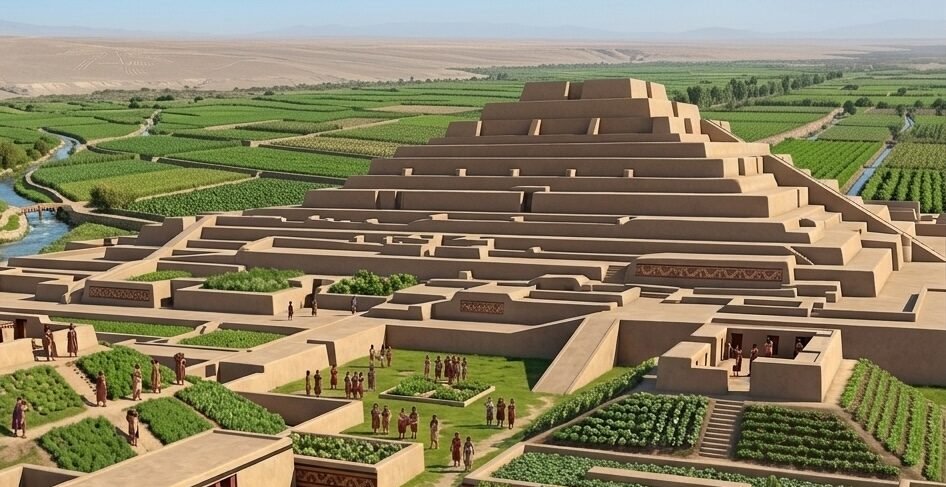
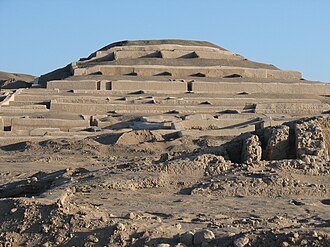
These ancient Peruvians built Cahuachi, a huge, monumental city with stepped pyramids which, Archeologists tell us, they never lived in. We know this because nearly all of the pottery we find in excavations has been beautifully decorated, and there are no large trash heaps. A proper city contains plain pottery and lots of trash (as San Francisco is daily proof).
No. This was a ceremonial city, where the inhabitants of local villages went for a quiet weekend away. There, they unwound, imbibed psychoactive plants, and, if the boys were feeling extra rowdy, sacrificed a few camelids and perhaps one of the neighbors.
Then the Earth’s climate changed. I know, I know, climate change without fossil fuels? Without nasty humans at fault? Never fear! Even in the distant and unenlightened past, some already believed in human-caused global warming.
The Nazca worshipped, if you recall, a rain-god called Kon. They theorized that lack of rain was a sign that Kon was angry with them. And, to appease him, they upped the number of human and animal sacrifices, and began to work on a new kind of geoglyph. These designs weren’t cheerful-looking people, and they weren’t even visible from the ground. They were drawn on the surface of the high desert plain, scraping back the thin topsoil to expose the white volcanic layer beneath. It only took a matter of days, perhaps as long as two weeks to make each of the the individual designs that we call the Nazca Lines, and if one giant figure was good, surely a few dozen would be even better.
As far as we can tell, the Nazca lines were meant to remind Kon of their shared history and convince him that they were deserving of rain.* And they worked—sometimes. There were occasional good years, but then the weather turned dry again, only seeming to prove that the bad years were the result of the terrible luck that came to anyone who withheld anything from Kon.
Seven Years’ Bad Luck
Terrible luck isn’t only an ancient idea. Modern sports fans will go to almost any length to avoid mentioning that a perfect game is in progress. If someone does mention it, we all know it’s his fault if the game goes south. Hospital nurses will not say “it’s been a quiet night” because every time the “Q-word” is spoken, everything falls apart. Of course, we don’t actually believe that talking about a baseball pitcher’s ongoing no-hitter will cause it to end, but does that mean that we’re going to tempt fate? Oh no, not at all!
Let’s say you always write “go team” in the dust on the back of your car, and your team has winning streak that brings them within one game of the championships. And then you forget, and your team is hammered by a bunch of nobodies from nowhere—will you be more or less inclined to write the slogan next time? Now, imagine you’re a farmer, and the year you don’t make a geoglyph, two of your children die of starvation.
And what won’t fear of disastrous climate change do to a generation, in any century? Heaven knows it’s caused a stir in our culture, and we aren’t even starving. If the trees were dying and you hadn’t seen green grass in a year and starvation slept with you at night and walked with you each day, if the sky lost it’s color and the soil blew away with your precious seeds, you could accept it all with some measure of patience—unless there was someone to blame. If Chimal’s impiety or Chad’s F450 is causing the drought, there is no law, no punishment, and no inconvenience you cannot justify. No matter how nonsensical the remedy may be, it will be tried, and cursed be the man who doesn’t help.**
The Nazca’s drought wore on, getting more intense with each passing decade. Like shipwrecked men on a punctured life-raft, the Nazca tried everything to attract the attention of their gods. Some of the neighboring cultures began to sacrifice children and pregnant women to the rain-god, their heads removed and planted in the ground as seeds from which new life was supposed to spring. The Nazca began sacrificing children, too. After all, what might happen if they refused?
From Bad to Worse
Sometimes, as if to show the god’s fury, rain came—in storms that slammed into the Peruvian coast, lashing the now-bare ground with rain and forming flash-floods that ripped away precious topsoil, carrying it away in swollen brown streams before dumping it into the Pacific Ocean.
A massive earthquake destroyed the grand city of Cahuachi, reducing the temples where children had been sacrificed to rubble. Was this a sign that the priests had failed, or the people? Either way, the ruins of the city were intentionally covered in a layer of dirt and abandoned. Without Cahuachi, there was less to unite the Nazca, and with the ongoing drought came more reason to envy one’s neighbor’s land and water. It is much more pleasant to sacrifice someone from the next village over than to sacrifice one’s own friend. Headhunting surged in popularity.
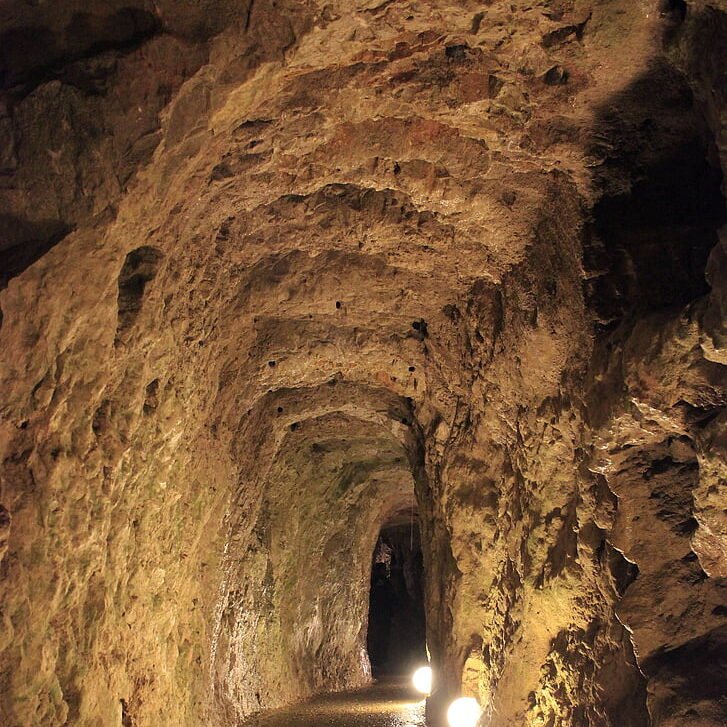
With normal water sources failing, the Nazca built an elaborate system of underground aqueducts to tap into subterranean aquifers. Tunnels carried the water from village to village. To keep the water flowing, they built “chimneys” into the underground canals in the shape of corkscrewing funnels, which caught prevailing winds and channeled them into the tunnels, increasing air pressure and helping to move water through the aqueducts.
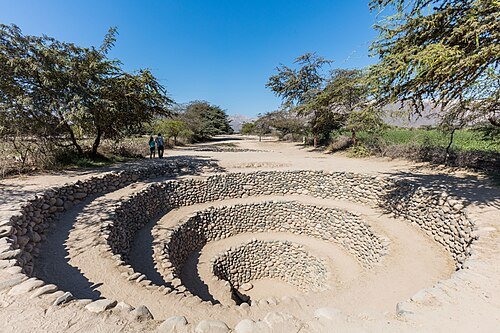
As decades turned into centuries of drought, even the aqueducts dried up. Kon didn’t respond. Like Ba’al in the Bible, maybe Kon was musing, or relieving himself, or he was on a journey, or perhaps he was asleep. The Nazca dwindled. Some migrated away, and another South American people invaded and colonized those that were left.
The Nazca are gone, only their cloth and pottery remain, preserved by the dry climate that was their ruin.
And we also have the lines, the ruins, and the remains of countless human sacrifices, which tell a story of a people who did terrible things, not because they were so different from us, but because they were the same.
What the Nazca got right
The Nazca weren’t all wrong: humans caused the drought, although not directly.
This world was created perfect, cursed in Adam’s fall, and ripped apart in the flood, and it’s never really been the same since. Although the worst of the super volcanoes, earthquakes, and massive climate shifts that immediately followed the flood have died down, and some level of normalcy has been attained, this planet is still a messy place. A broken place. Hurricanes, earthquakes, flood and fire, like players on a giant stage, still act out the ugliness of sin.
But that’s not where the story ends. A sacrifice has been made, not as a bloody bribe to to a thirsty god or a superstitious knock-wood, but a legal contract, purchasing us from the same bondage to fear and sin that plagued the Nazca.
Adam’s fall created this mess. Jesus’ self-sacrifice has already begun to mend it, reversing the curse of sin—first in our hearts, where we are capable of the same fear-driven cruelty as the Nazca, and then in our hands, as we work together to take dominion over the broken creation we have been entrusted with, and last of all, in the final renewing of our home planet.
And that is something to look forward to.
* I really, really wish I could find creditable evidence that the designs were a runway, or astronomically aligned. Unfortunately the lines are inset into the surface, making them unusable as a runway even for today’s airplanes, and the number of lines that match up with astronomical phenomena is exactly the number we would expect to find from a box of spaghetti noodles, accidentally dropped on the floor.
**I am specifically not saying that putting diapers on cows to reduce greenhouse gasses is the same level of odd as drawing pictures for rain gods.