Ancient Cave, No Good Explanation: The Longyou Grottoes
Wu Anai’s life, like the lives of so many rice farmers in central China, afforded few options for entertainment. He awoke, farmed rice, went to sleep, and repeated the process. However, like many of his Western cousins, he found relief from this looping circle of productive boredom in the exciting and honorable sport of fishing. When rival fishermen caught a 44lb fish in a local pond, Wu wondered why such a fish hadn’t come his way. Surely it wasn’t his bait. It was not his skill. Could the fault lie in the pond itself? Wu was determined to get to the bottom of the mystery.
Wu gathered his friends Deng, Chen, and Mao Ronggui and somehow convinced them to drain one of the ponds. As Deng said: “[We thought] maybe there would be something to be gained. . . No matter how bad it is, if we can pull out some big fish to sell, in a word, we will not lose money.”
Not lose money draining a fish pond? One wonders exactly what Wu told his friends.
Having procured a pump, the four friends began to drain the murky water out of the small pond. For a day the pump labored, taking only a few quick breaks to have mechanical problems, as is the nature of pumps. For a week it pumped. For two weeks. And on the seventeenth day, with a gurgly gasp reminiscent of a deer realizing that hunting season began yesterday, the pump stopped.
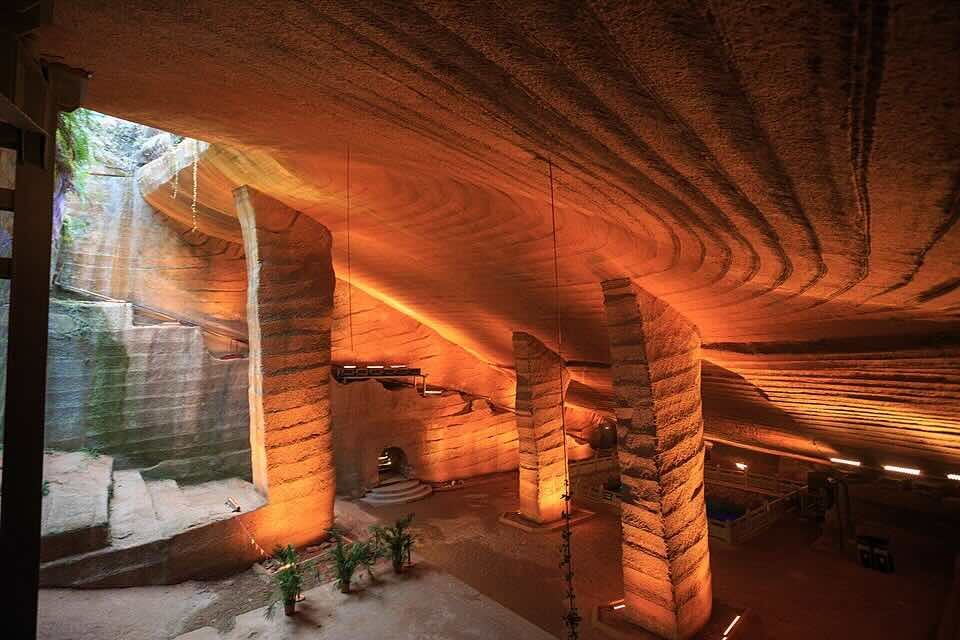
The farmers gathered around, drained but eager. A vertical shaft disappeared into the earth before their astonished eyes, with smooth, perfect walls—rock-solid evidence of human engineering. The walls opened on one side into a massive pillared grotto or room.
They had discovered the first of the Longyou Grottoes, some of the largest manmade single-room caves in history, with a flat floor, pillars, and a roof sloping inwards into a massive room, empty except for some small sculptures, mostly of farm animals, on the walls. (These older carvings are not to be confused with the huge new carvings which were added almost immediately upon discovering the caves. For why? For cool vibes, that’s why.)
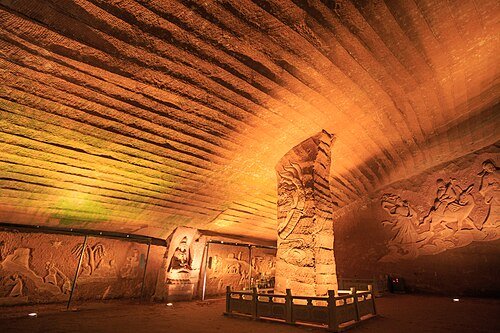
And that isn’t the half of it. When the discovery was made public, researchers discovered the cave was but one of 24 grottoes within the same small area, all equally massive or even larger. Some of the caves at Longyou Grottoes have ceilings so high that a ten-story building could fit easily into the cave. All of them have walls, ceilings, and pillars carved with the same distinctive horizontal ridges, and one of them, Cave 7, appears to be unfinished, with the flat floor stopping halfway through and a few stone blocks left partially carved on the floor. The advanced engineering evident in the cave’s construction has spawned an entire series of YouTube videos, with claims ranging from the intriguing to the absurd.
The Longyou Grottoes remain enigmatic. When were they built? Why on earth would anyone spend years carving hundred-foot ceilings of solid rock in ten separate caves so close to each other, (in one spot, little more than a foot separates the caves,) without ever digging a tunnel to connect one to another? And what was their original purpose?
The going theories among Those Who Know are that the caves were built either as a secret military staging ground for the imperial troops, a really fancy storehouse, a quarry, or some species of Taoist temple. But all these theories are as full of holes as a colander of Swiss cheese. Why would any emperor, however imperial, build for his army secret staging areas of such magnificence? Could such massive caves have been built in secrecy at all? And why hide your army in many elaborate ten-story caves with no connecting tunnels carved out of solid rock, instead of utilizing one of the many tried-and-true methods of hiding armies down through the ages?
Then there is the storage theory. After all, caves are excellent for food preservation, what with their shelter and cooler temperatures. Unfortunately, this theory only makes sense if the ancient builders enjoyed moldy food.
Each cave was designed with an elaborate system to channel rainfall entering the cave into neat little rectangular tanks. The ancient builders also provided for some seepage due to the fact that the caves sit below the water table, but… not enough. Archaeologists agree, (as much as archaeologists can agree on anything,) on a construction date of roughly the first century B. C., which they arrived at by the simple method of assuming that the caves couldn’t possibly be older than the handful of pots found there. The last time the caves would have been dry enough to store anything of value was during the Ice Age. If the caves were built as late as 50 B. C., they never have been dry enough for storage.
As for the temple theory, I think it’s a total wash. One damp cave may be a temple, but twenty-four? And why were the caves left largely undecorated, with no obvious altar or place of worship? Also, I mistrust the tendency to chalk up every mysterious ancient location to religion.*
It could have been a quarry, but the rock in the area isn’t particularly useful, and why not dig a hole in the ground, instead of going to all the trouble of leaving a ceiling?
In point of fact, none of our theories make a lot of sense. As a local Chinese newspaper put it, “When you enter the cave, you are full of explorers, and when you leave the cave, you are all guessers.”
Of course, there is one more possibility, although I don’t like to mention it in mixed company. . .
We’ve been told ancient humans were either demigods toying carelessly with advanced technology or ignorant savages trying to figure out what soap is. But what if—drumroll, please—they were both, and neither?
What if the ancient builders, skilled masons all, built the Longyou Grottes without properly accounting for the constant seepage? Almost (but not quite) as though they also were fallen humans created in the image of eternal God? Could they be brilliant and fallible?
So what do you think? Were the builders absentminded geniuses who forgot to check the water table, or just incredibly optimistic? Is it possible that the Longyou Caves date back to the last time the water wasn’t a problem, during the Ice Age caused by the Genesis flood? Or is there a simpler, but still missing, explanation hiding in plain sight? The floor (what’s left of it) is yours.
*One can only imagine what future generations will think of such wonders of modern architecture as the Obama Presidential Library. Come to think of it, it would make an excellent temple for the sort of pagan god that requires constant sacrifices of mostly innocent goats.