
The Antikythera Mechanism: Cicero’s Mic Drop on Modern Science
Once upon a time, archaeologists discovered what was the equivalent of finding an iPhone in a time capsule from 1950.
What they actually found was a mysterious lump of corroded bronze on a shipwreck from 60BC that proved to be a device so brilliantly ahead of its time, so crammed with anomalous technology, that some believe it was left behind by a careless time traveler along with his spare handkerchiefs. Among other advanced technologies, it contains differential gears, which were invented 1,800 years after the ship broke on a rock-bound coast and scattered her treasure across the bottom of the Aegean Sea. It has epicyclic gearing, which was invented 1,200 years later, and pin-and-slot mechanisms for variable angular velocity, invented 1,500 years later. And the list of obscure but wildly important mechanical pieces goes on—ten to fifteen different technologies that should never have been found amid the pottery and statuary of a ship from the first century before Christ.
We call it the Antikythera mechanism.
Since its discovery 120 years ago, historians and archaeologists obsessed, fought, and wildly hypothesized about every detail of the device, all while deliberately disregarding the written testimony of a man who was alive when it sank. But I’m getting ahead of myself.
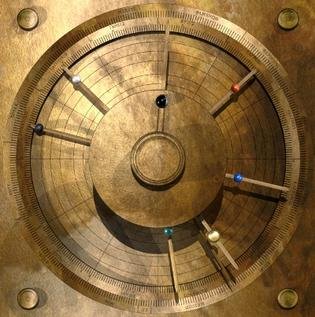
Before the Antikythera mechanism was a hunk of rusted bronze, it was a box with a crank coming out of one side. The face of the box contained concentric clock faces, one inside the other, each with its own dial hand. When you turned the crank to select a date in history, little spheres of colored glass representing Mercury, Venus, Mars, Jupiter and Saturn, as well as the sun and moon, would spin around the face of the box on concentric bronze wheels, until they arrived at the correct positions for that particular day. As a final flourish, the device’s tiny model moon was painted half white, half black, and it spun as it went, going from a full moon to a waning crescent and back again.
Huh. Someone (but not you) is probably thinking. Sounds cool, but not really that complicated.
That someone (who isn’t you) is in error. Grossly mistaken. Out of his or her depth. Treading water in a typhoon.
And I’ll tell you why: From our viewpoint on earth, the planets appear to slow down and speed up as they travel across the sky. That means you can’t just use normal gears with one tooth per day, 28 teeth on the moon’s gear, 398 on Jupiter’s [1],etc. Oh no. Instead, you have to do mind-numbingly complicated things to make Jupiter slow down just as Mercury speeds up, to make Saturn turn around and wander backward while Mars leaps and Venus lags—and all at the most inconvenient and seemingly random times. No planet can simply march around the face of the Antikythera mechanism like Joshua at the Battle of Jericho, or the calculations would come tumbling down.
And each of these gears, moving planets which slow and speed and occasionally go backward, has to be precisely calibrated, perfectly positioned, and so thin that the entire device is the size of a shoebox.
So why would anyone endure so much math? Such a Golgotha of geometry, and agony of algebra? What was the device’s purpose?
Funny you should ask. The Antikythera mechanism has one useful function outside of astronomy and astrology. It could be used to navigate a ship. But although we found the device on a 50 meter long ship capable of sailing the Atlantic, where navigation is mildly useful, scientists are pretty sure that it was only used for astrology.
As for who made the device, Cicero, a Roman patriot and senator who lived in 60BC, claims a similar machine was built by Thales of Miletus around 500BC, after he traveled to Egypt and Babylon to learn astronomy from their scholars. The Antikythera mechanism uses Babylonian astronomical calculations[2], but that’s no proof that ol’ Cicero knew his hat from a hole in the ground. If we were to believe him, the design was improved by another astronomer around 375 BC and perfected by Archimedes around 250BC. To hear Cicero talk, we might think that these advanced mechanics were widely known by ancient scholars, and the technologies involved were later lost. But we don’t think that, because that would be ridiculous.
Instead, many researchers find it more convenient to suppose that aliens or time travelers made the Antikythera device, because we all know that humans back then didn’t go to a modern College, and weren’t properly educated. This is not unlike me coming into a room to find a toddler, a lidless marker, and a new wall mural, and confidently blaming Casper the ghost. Just because the toddler COULD mark up the wall, doesn’t mean a ghost didn’t.

And, since the device involves eight to fifteen different technologies that were, separately, huge leaps forward in our understanding of mechanics, most experts assume that if the device was made by ancient humans, it was a one-off, invented by some nerd in the ancient equivalent of a basement.
And Cicero, who really would not shut up, has one more bomb to drop—and this is his most inconvenient and widely ignored comment on the subject.
And I quote:
“Suppose that [an Antikythera mechanism] were carried into Scythia or Britain. Who among the people of those barbarous lands would doubt that such a perfectly constructed device had been made through the exercise of reason?
“Yet these same people doubt whether the universe, from which all things arise and come into being, is the product of chance or necessity rather than the work of reason and a divine mind. In their view, Archimedes displays greater skill in reproducing the movements of the celestial sphere than nature displays in producing those movements themselves—even though the imitation falls infinitely short of the original.”
If you didn’t catch that, Cicero just claimed that anyone with common sense couldn’t fail to see that the universe was created by an intelligent God. It’s almost as if Cicero doesn’t realize that he’s the backward ancient, and modern experts who believe in the modern idea that everything we see is the result of chance are the educated ones.
Burn.
[1] The device was tracking Jupiter’s synodic period, not its total orbit, which is 4332.59 earth days. And if you know what that means, please let me know. I refrained, with Herculean effort, from looking it up myself, in an effort to keep this article shorter than both the synodic and orbital cycles combined.
[2] The Babylonians, and the makers of the Antikythera mechanism, used a standard 3:2 ration of longest to shortest day of the year. It was neat, rational, and not exactly precise for anyone except those who lived near the 35th parallel, but it worked.