Billionaires, Please Read: The Lost City of Thônis-Heracleion
I think the super wealthy have an obligation to go forth and entertain the rest of us.
Not through drama (we don’t need rich folks to generate that,) and certainly not by starting wars. History is peppered with the super wealthy acting on the misguided belief that a nice little war would liven us all up.
Wars rarely liven anything. No. Instead, they should do interesting things.
Go to Mars. Decipher a lost language. Discover a buried city.
Today, I present a shining example of all that one ought to do with financial independence: a Frenchman by the name of Franck Goddio.
At 36, Franck Goddio, a financial advisor to the government of Saudi Arabia, had money and prestige. Success was his. But having accrued his pile, he felt something was lacking. As he said, “After 10 years I took a sabbatical, thinking I must do something interesting. I had always been fond of archaeology, I loved the sea and I was a sailor, so I thought: why don’t I study what is being done in underwater archaeology around the world?”
As an underwater archaeologist, Franck began small. Several Spanish galleons, a Chinese junk from the Ming dynasty—you know, just your basic ancient treasure. Some gold, some jewelry, a few crates of artifacts, nothing Clive Cussler’s Dirk Pitt wouldn’t have done, only Franck donated his findings to museums.
On one of his first dives, Franck heard rumors of an underwater city at the mouth of the Nile spotted during World War II by an RAF fighter. Although the report had generated a good deal of interest, no one could find whatever it was the pilot had seen.
Franck was intrigued. Searching ancient texts, he found references to two possible candidates for a sunken city: Thônis and Heracleion. Heracleion was founded in the 12th century before Christ, and grew to become one of the most influential cities in Egypt before Alexandria stole its thunder.
It was there that Helen of Troy and Paris were said to have come asking for refuge just before the Trojan War. (By most accounts, they were turned away by the pharaoh of Egypt, who wasn’t born yesterday, and didn’t want no drama.)
The city vanished from memory and record between 600-800AD. Modern historians speculated about where the city could be, or if it ever existed. After all, any city visited by Helen of Troy falls under immediate suspicion of being purely mythological.
Franck Goddio was certain Heracleion had existed. Because he was not a traditionally trained archaeologist, the archaeological community, while always open-minded towards those with deep pockets, remained skeptical, but Franck persisted. He began scanning the bay, searching for the lost cities, using tech that sounds like something from the Hitchhiker’s Guide to the Galaxy: Parametric Sub-Bottom Profiler, Multi-beam Bathymetry, Sidescan Sonar, Nuclear Magnetic Resonance Magnetometers, Acoustic Positioning Systems, and Dilithium Anti-Matter Reactors. *
After four years of gathering data from his high-tech tools, Franck ran the results through statistical models on his computer and came up with the most likely location for a sunken city. He hired a boat and a diver and went to work.
Picture yourself about 12 feet deep in really gross water, continually soured by the waste from around 40 million people living in nearby cities. The water is in a constant state of pea-green soup. Visibility is so bad that sometimes it’s easier to just close your eyes, since swirling particles of only God-knows-what in the water not only obstruct your vision, but make you dizzy.
There, where the sewage meets the sea, they made their first dives, and immediately discovered the same thing all previous dives had; a silty and almost featureless bottom. Green and grey sands stretched away as far as the eye could see in the cloudy depths–that is, for an entire meter.
No city.
But Franck was confident in his scans, and the dives continued, oxygen humming away into little bubbles in the swirling silt, the diver resurfacing, blinking in the blinding light of the Egyptian sun to report nothing of interest, back down again for a few more hours. A day passed, and another.
After years he’d spent scanning the bay, nothing.
The dives continued. A few days later, a diver came upon something dark looming in the murky water. A wall of hewn limestone. The news electrified the crew waiting on the boat above. Another dive, a dozen meters away, revealed the same wall. And another. The wall was 150 meters long, and it didn’t take long to realize that it wasn’t a wall at all–it was an enclosure.
After 1500 years, they had discovered the central temple of the lost city of Heracleion.
Inscriptions revealed, to their surprise, that they had discovered not only Heracleion, but Thônis as well: the two cities of antiquity were actually one city with two names, one Greek, the other Egyptian.
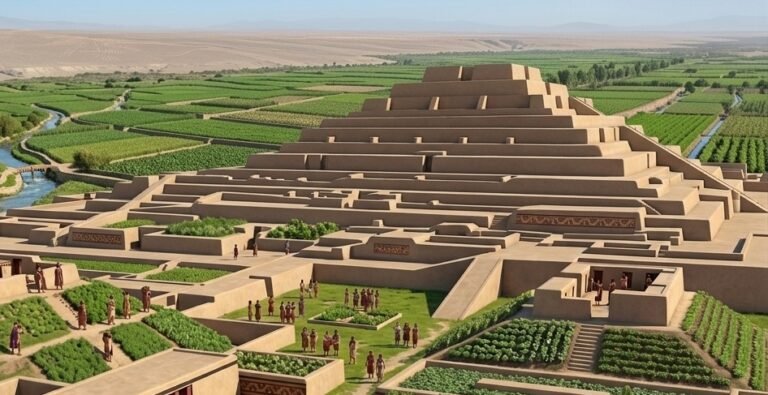
When you think of Thônis-Heracleion in its heyday, you need to picture a city built on water, like an ancient Venice, with wide natural canals branching between vast temples of red granite and limestone built on a network of small islands. It was a port city where the Greek and Egyptian worlds mingled. A city built on scattered sandbars.
Armed with giant underwater vacuum cleaners, Franck and his team attacked the muck. Over the next years they sucked up yards of it, and under the silt, they made discoveries that would satisfy any explorer’s wildest dreams.
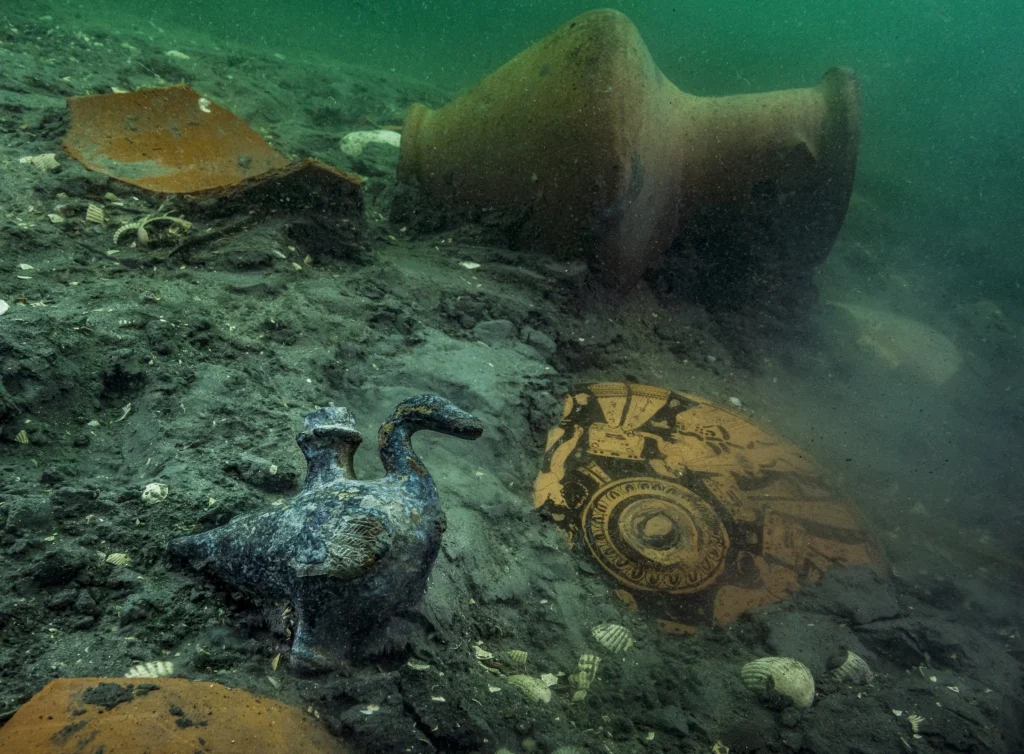
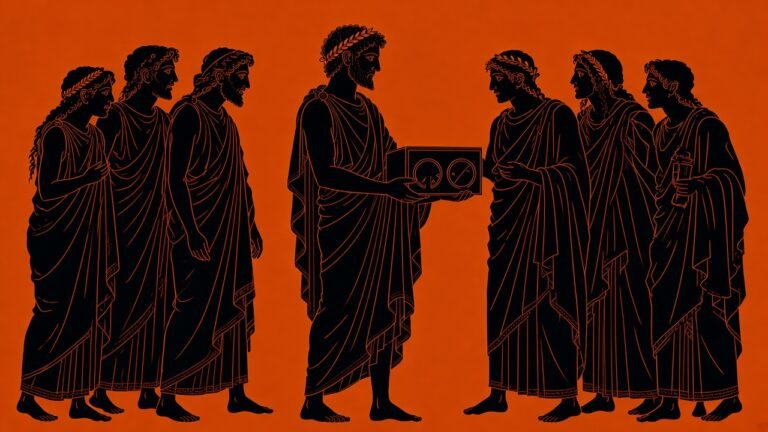
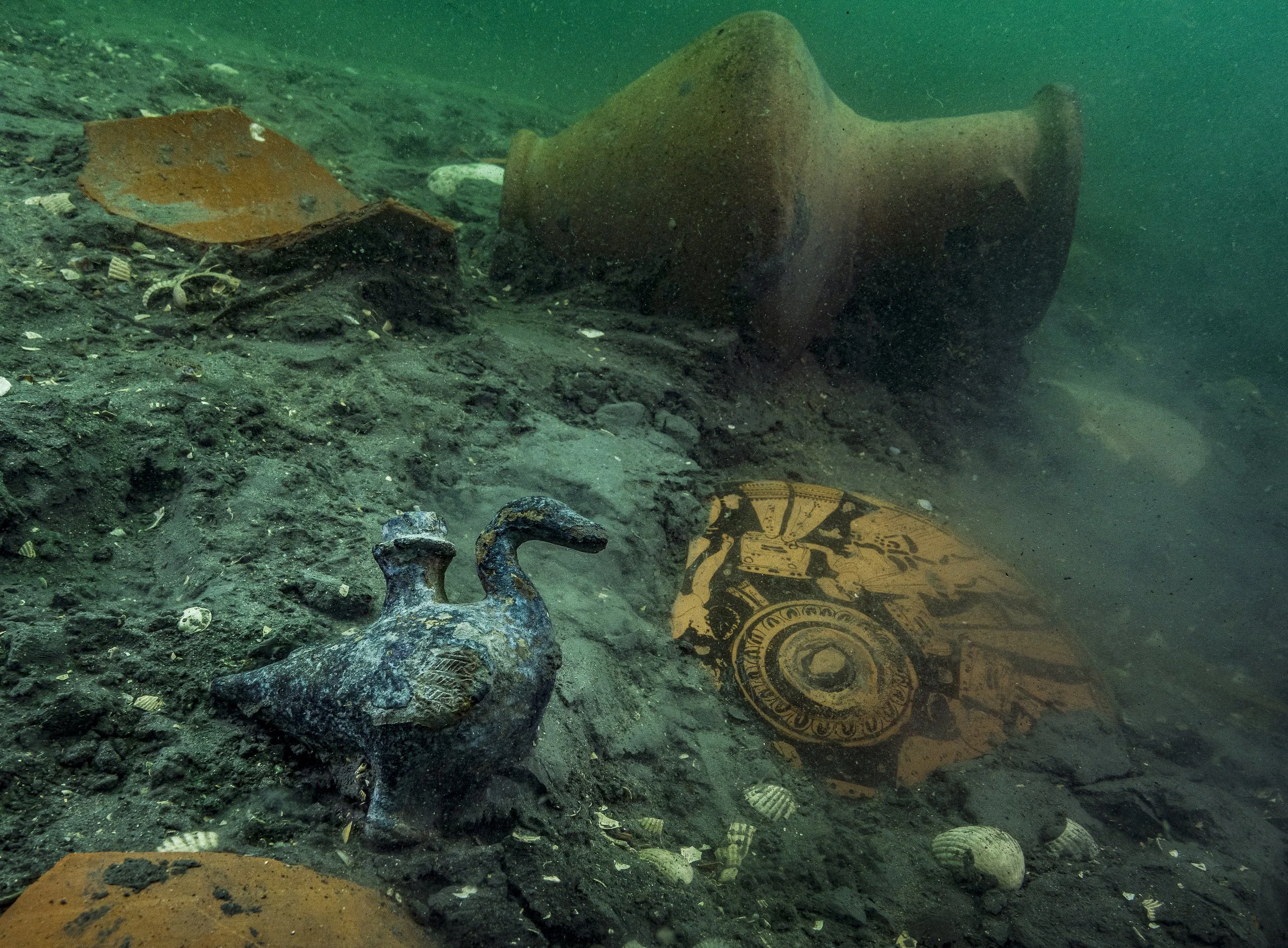
The mud-brick houses had long since disintegrated, but what remained was astonishing. Perfectly preserved Greek pottery, with burnt red figures of dancing girls and musicians etched on the black surface of curved pots.
Coins, children’s toys, the wooden frame of a sofa.
Shipwrecks, dozens of them, some obviously designed for the open sea—something that the Egyptians of this period were not expected to do. They found colossal statues, stele, inscriptions, bowls, and jewelry. Someone’s lunch, still in its bag. Sacks of palm fruit.
In one location, it appears that sailors and their families tossed valuables into the sea for “luck” or perhaps to thank the gods for a safe voyage. Their offerings scatter the entire area.
What destroyed Thônis-Heracleion ?
So how did the city end up under the ocean?
From what we can gather, an earthquake around 150 BC liquefied the saturated clay soil under the city, turning the ground to rippling quicksand. Temples sank into the ground, stones toppled, walls tumbled. And when the shaking stopped, the water trickled over the wreckage of the largest islands.
Every year the water rose just a couple more inches as sea levels crept higher, and the city continued to slump into the ocean.
Several hundred years later, the cataclysmic earthquake of 365AD liquified the soil yet again and sent almost everything that remained slipping beneath the water. An earthquake in 880AD completed the process, and the city vanished from history.
So far, they have uncovered only about 5% of the city. In the years to come, we may discover more clues about the city’s last days. Are the skeletal remains of its ancient inhabitants still waiting to be found beside their pots and jars? Or did they escape?
If you have the time, be sure to watch this video. There’s nothing like witnessing a diver brush away the silt covering a pile of gold coins, or lift the face of a statue towards the light again for the first time in 2000 years. Oh, and if you happen to be a billionaire with extra money, please go do something interesting.
You can learn more about the lost city and Franck Goddio here.
* No, not really. I just wanted to see if you were paying attention. You passed!