Why We Haven’t Found Noah’s Ark – and Probably Never Will
Some of you have probably long suspected what I’m about to tell you about Noah’s Ark, but in all the wide world of internet legends and reddit rumors, I believe I am the first (I say it with all proper humility,) to finger the Iron Age Scots as possible culprits.
If you haven’t seen it in the news, Andrew Jones of Noah’s Ark Scans thinks he’s found the Ark in the hills of Turkey, and he points to a giant wedge-shaped formation on a hill near Durupinar as proof. At this point, he is “One hundered percent positive.” He told FoxNews: “I do believe that this is the real, decayed, buried remains of Noah’s Ark, the famous ship. And we’re doing our best to convince the skeptics and show the world this site.” It’s not the shape alone that has caught people’s attention. His scanners appear to have found man-made tunnels within the shape, going down the center of the formation and on the inside edge of the hull shape. “We really believe that this layout, showing tunnels and also possible support beams and walls, would suggest that it’s a man-made object and not just a natural formation.”
Andrew Jones seems to be an earnest man who truly cares about the work he does. The dimensions of the site do match the biblical description of Noah’s Ark, and the soil inside the formation contains 2.5 times more organic matter (like decomposed wood?) than the soil outside. As further proof, Mr. Jones points to the name of a town some ten miles away from the site called Arzep, which translates as Valley of the Eight*, possibly referring to the eight survivors of the flood. Another area nearby is named Kargakonmaz, meaning Where the Blackbird Will Not Land*, which, again, reminds us of the Genesis flood story.
Reuse, Reduce, Recycle.
Mr. Jones isn’t the first person to claim to have found the Ark, but he is one of the few who don’t claim to have found it in near-intact condition, with hallways and stalls you can still explore. I think this makes his theory all the more plausible.
Imagine you step out of the ark into a planet you no longer recognize. In the distance, hot lava seeps from the torn earth, and volcanic ash permeates the air with its sulfuric stench. The forests and cities you once knew are gone. Mats of rotting vegetation puddle the landscape, bright green shoots of fresh grass springing up in their shade. The wind lifts the collar of your tunic and runs icy fingers down your back, and your tiny flock of animals begins to scatter down the mountainside, taking all hope of wool and milk with them.
You need to get off the mountain and build a shelter somewhere below, a shelter with pens for your livestock and storage for your supplies. In this post-apocalyptic survival situation, fuel and lumber are some of your greatest needs.
Would you gaze at the Ark, looming above you in all its wooden glory, elbow your brother and say, “Live or die, we can’t use that wood. Imagine how disappointed future historians would be!”
I’m sorry, but I don’t see how anyone can believe Noah had a glimmer of sense and cling to the hope that Noah’s Ark lasted as a boat after it landed. Why wouldn’t it be hauled away for fences and buildings, shaped into cradles and coffins, and carved into wooden dolls and plows?
Bits of staircase might have become trellises for grapevines, and odd scraps burnt for firewood. The Bible tells us in Genesis 4 that the pre-flood civilization had bronze and iron—which means that even unusable wood would be pulled apart to recover bolts. No one object has probably been so thoroughly plundered in all of human history. Heartbreaking, but true.
Theoretically, the Durupinar formation could be the location of a plundered ark, and the faint readings could be mineral deposits left by the wood after all but the tiniest fraction was removed. But that’s not what Mr. Jones’s or his coworker Lauren Witzke say. They believe the ark is materially intact, that it wasn’t taken apart because Noah’s sons moved away too fast to do so, and Noah and Mrs. Noah didn’t need the wood. Except that we know that the sons stayed with Noah long enough for him to plant a vineyard, play out a bit of family drama, and curse his grandson, Canaan. One does like to think Canaan was at least in his early teens by the time the curse descended.
Alas, Alas
Unfortunately, the theory has one big ugly snag. The Durupinar formation is found in a 3280ft deep valley on the southern slopes of the Mountains of Ararat. This is a problem, given that the ark landed “on the mountains of Ararat” on day 150 of the flood event, and according to the Bible it was not for another 74 days that the tops of surrounding mountains were seen.**
If the formation was the landing place of the ark, Noah would have had to be extremely shortsighted in order to not notice a veritable forest of mountaintops from the Ararat mountain range looming behind him for those seventy-four days. Even if he had bad sight, one hopes that the dove or raven would have given him a hint. And since the formation is on a very young, growing volcano that last erupted in the 19th century, while the peak we call Mt. Ararat likely rose during the flood, the height difference would have been even worse back then.
A Brave New Theory
If the Durupinar formation isn’t the Ark, what is it? What are underground tunnels or cavities running down the middle of the formation, as shown in recent scans? Well, if you really want to know, those lines could be caused by natural geophysical contrasts created by a doubly plunging syncline, combined with layering in the sedimentary rocks.
I know what you’re thinking—nice way to kill a fun theory, science. I almost yawned just writing the paragraph above. Which brings me, quite logically, to the Scots.
If we are to do archaeology by matching shapes, then I would like to propose A New Theory.
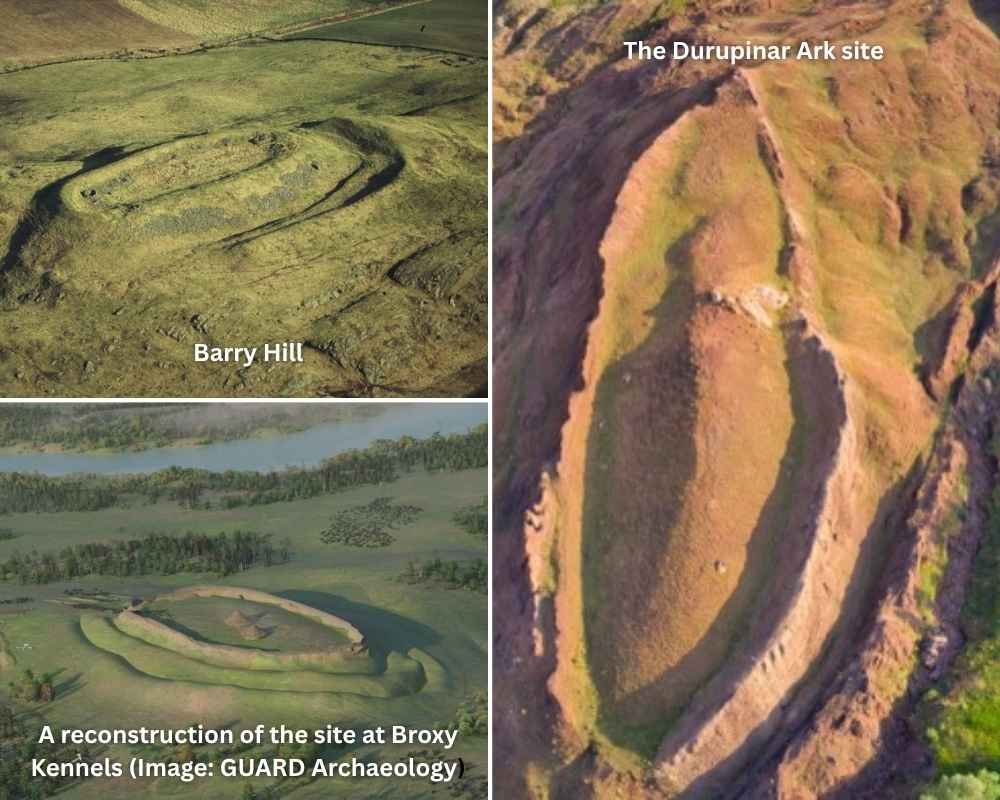
What if the Durupinar formation—assuming it turns out to be manmade— is nothing more or less than a hill fort like those that dot the United Kingdom, concentrating in Scotland?
The shape is similar.
It has underground tunnels. Classic Pictish forts do, too.
Some may object that the formation in Turkey has only one ring, whereas hill forts contain many. I would invite these skeptics to google “univallate hillforts.” Besides, the Durupinar formation appears to have at least part of a second concentric circle, which is not at all explained by the ark theory.
Skeptics may point out that no evidence of human habitation has been found at Durupinar. Well enough, but Quarley Hill in Hampshire, England, also shows no such signs, and do people question its identity? No, they do not. Discrimination!
Again, detractors may point out that the Bronze Age Scots were never in Turkey. I fall back to that strongest and most worthy of all arguments, proof of the negative kind is hard to come by.
I add a raised eyebrow and a dry laugh, and mention that defensive earthworks on hills are not a uniquely Scottish idea. The Norse, the Gauls the Siberians had hillforts. The Pre Colombian Native Americans also built earthworks on high places—although Modern Researchers have decided that they only did so for fun and ceremony, not for practical reasons. One of the few things Modern Research has shown for sure is that ancient peoples loved spending years building things with no purpose.
Ah, that’s the problem, isn’t it. The site is far too old to have any practical function—Perhaps it would make my idea more palatable if I propose the site to be a hillfort, built “just for ceremony,” that purposely imitated the size and shape of the Ark?
Now that’s a theory!
*As far as I can ascertain, these are actual names, not just one of those inaccurate but exciting zingers that make their way around Christian culture with complete disregard to boring old facts.
** At this point you should be asking how our planet ended up with enough water to cover Mt. Ararat, and where it all went afterwards. Quick answer: there isn’t enough water to cover Ararat at its present height. The mountains we see today were formed by tectonic and volcanic forces during the later part of the flood. For a long answer, see this article.